
An Indian AI Research Organisation official says India has adopted a balanced and pragmatic approach to AI regulation, avoiding the extremes of the US and EU models.

While many areas compete for resources, defence, education, and adaptation deserve focus for maximum impact, suggests Laveesh Bhandari.

'Our problem is not a budget deficit but a trust deficit. We need to trust our institutions and industries to innovate and lead. That is the way forward for India.'

Sustaining 8 per cent-plus growth rates is necessary if we are to reach high-income status by 2047, points out Amitabh Kant.
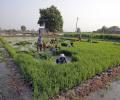
'They are totally disconnected with farm activities which their families have been involved in for years.'

Sri Lanka stays with you not just in memory, but gently reminds you what a society can achieve when heart and heritage guide the way.
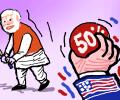
'Things may get much worse before they get better,' predicts Ajay Chhibber.
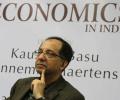
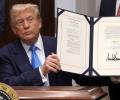
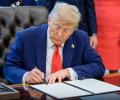
Former World Bank Chief Economist Kaushik Basu on Thursday said the US economic policy towards India has taken an unfortunate turn, noting that President Donald Trump's harsh stance against New Delhi appears baffling. US President Donald Trump on Wednesday announced a 25 per cent tariff on Indian goods from August 1, amid signs of a stalemate in the ongoing bilateral trade negotiations between the two countries.

Brave statements such as we will continue to be the fastest growing large country are of no consolation, because the direction of trade also determines the flow of investment, points out M Govinda Rao.
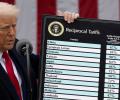
US President Donald Trump has proposed a deal to China that would see the sale of TikTok's US operations to an American buyer in exchange for a reduction in tariffs on Chinese exports to the US. The proposal comes amid a trade war between the two countries and follows China's retaliation of Trump's tariffs on Chinese goods. Trump has also said that tariffs are a powerful economic tool and that he is determined to ensure fair trade between the US and China.
For India, the challenge is to strike a balance between tactical necessity and economic priorities, point out Pravin Krishna and Monil Sharma.

China's leader-in-waiting Xi Jinping made his first public appearance on Saturday after two weeks of a much-talked-about absence, putting to rest for the time being rumours about the vice president's illness.
The collective West has always opposed strong leaders and economic development in India, asserts Colonel Anil A Athale (retd).

'We should watch -- in the near term -- for signs that the two have totally fallen out at a personal, political level.' 'Trump and Modi know how to be dealmakers, but they also know how to hold a grudge.'
'That way you're not hostage just to US sort of exports to India.'
'It's important for India to think about areas where it wants the US to move.' 'We can be far more innovative in what we ask the US.' 'Given that there's a package deal, why not do it?'
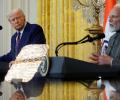
'But I don't think the government is in a great hurry to sign the BTA.'
Chinese Vice President Xi Jinping, who is expected to succeed President Hu Jintao, on Saturday made public appearance after over two week long absence which sparked speculation that he was seriously ill.
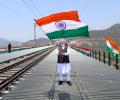
There are challenges galore before him, and it is not going to be easy. In the next four years, he has to conjure a system that changes the optics about him and the BJP both nationally and internationally so that he can ride back on his own, claim the top slot, and not have to lean on a coalition, asserts Ramesh Menon as Modi 3.0 completes a year in power.
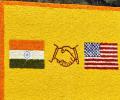
The Budget has given signals that India is sensitive to the US needs and willing to walk the extra mile, but if need be, we should respond in equal measure as a sovereign nation, notes Ajay Srivastava.
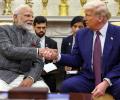
India should convert the Trump threat to an India opportunity, re-embracing a more liberal trade regime as a way of reviving manufacturing output and exports.
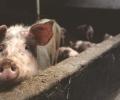
The study noted that humans are not protected from the G4 virus by the immunity offered by other human influenza vaccine strains, indicating that there is no preexisting population immunity to the virus.

rediffGURU Dr Pananjay Tiwari lists the options and cost of pursuing an MBBS education outside of India.

India should encourage the second coming of SAARC with climate change as an urgent agenda and keeping Indian security concerns in mind as the subtext, suggest Lieutenant General Ashok Joshi (retd) and Colonel Anil Athale (retd).

Shigeru Ishiba is expected to prioritise strengthening Japan's military capabilities and fostering deeper international partnerships, particularly with India, with whom Japan shares significant strategic interests, explains Dr Rajaram Panda.

Beijing will be intently watching Washington's response for any hint of weakness. Xi Jinping, who feels China has a limited window of strategic opportunity, will be emboldened to take additional initiatives in the Indo-Pacific and specifically against India and Taiwan, warns Jayadeva Ranade, the former senior RA&W officer and China expert.
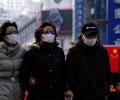
Eighty-six deaths were reported in mainland China with 3,399 fresh cases from 31 provincial-level regions, the country's National Health Commission said on Saturday.

Looking under the hood, I see India on the terrible, but commonplace, road to prosperity failure, warns Rathin Roy.

'Generating employment requires a shift in policy.' 'If not, the country will face economic, social and political challenges in the coming years.'

A strategist and a quintessential political leader with grassroots connect, Rajnath Singh is credited with expanding the Bharatiya Janata Party's organisational network in the Hindi heartland state of Uttar Pradesh in the 1990s and the subsequent decades.
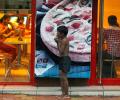
'Over the next 20 years, we would be adding almost 10 million people to the workforce every year!' 'And we won't be able to give employment to even 2 million out of the 10 million every year.' 'Don't forget, it keeps adding every year.'

India is not reaping the benefits of demographic dividends, former RBI governor Raghuram Rajan said on Tuesday, emphasising that there is a need to focus on improving the human capital and enhancing their skill sets. "I think we are in the midst of it (demographic dividend), but the problem is we are not reaping the benefits," Rajan said at a conference on "Making India an Advanced Economy by 2047: What Will it Take" at the George Washington University in Washington DC. "That's why I said 6 per cent growth.

The National Security Strategy document should flag all major issues concerning security strategy and provide guidelines to concerned departments to work out suitable action plans. Since the global and regional geopolitical canvas is dynamic, the NSS document should be deliberated at length before formulation and should be reviewed periodically, recommends Commodore Venugopal Menon (retd).
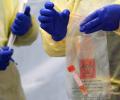
Bayannur, Inner Mongolia Autonomous Region, announced a level III warning of plague prevention and control, state-run People's Daily Online reported. The suspected bubonic plague case was reported on Saturday by a hospital in Bayannur.
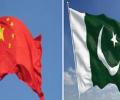
China on Thursday told Pakistan's new Prime Minister Shehbaz Sharif that it will always put its "all-weather ally" as a priority in its neighbourhood diplomacy as it praised his commitment to promote the USD 60 billion CPEC initiative.

Some areas in the Indo-Gangetic basin in India have already passed the groundwater depletion tipping point and its entire northwestern region is predicted to experience critically low groundwater availability by 2025, according to a new report by the United Nations.

'The policy focus of the government should have been on creating more good quality jobs but that was not their focus.'

Though the government has been pushing for exports of high-value manufactured goods across major markets in place of raw materials and input goods, India's top exports to China remain in the raw materials category.
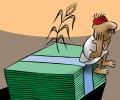
Lack of literacy is compromising the ability of farmers in India and China, two of the world's most populous countries with the smallest farm size, to raise productivity without losing soil fertility, says Kunal Bose.

India is among 120 countries which backed the draft resolution put forward by the European Union and several other countries.
 © 2026 Rediff.com - Advertise with us - Disclaimer - Privacy Policy - Sitemap - Feedback - About us - Terms of use - Grievances